12 Neutral Living Room Ideas That Make Every Single Day Feel Like a Retreat
There’s something almost magical about walking into a room that instantly makes your shoulders drop and your breath slow down. You know that feeling — the one where everything just feels right, calm, and beautifully put together without trying too hard.
That’s exactly what a well-done neutral living room delivers, every single morning and every quiet evening you spend in it. In this article, I’m sharing twelve of my absolute favorite neutral living room ideas — each one thoughtfully layered, deeply livable, and designed to help you build a space that actually reflects how you want to feel at home.
Whether you’re starting completely fresh or just looking to refresh what you already have, there’s something here that will speak directly to your soul.
The Layered Linen Sanctuary
Close your eyes and imagine sinking into a sofa so soft and breathable it almost feels like sitting inside a cloud.
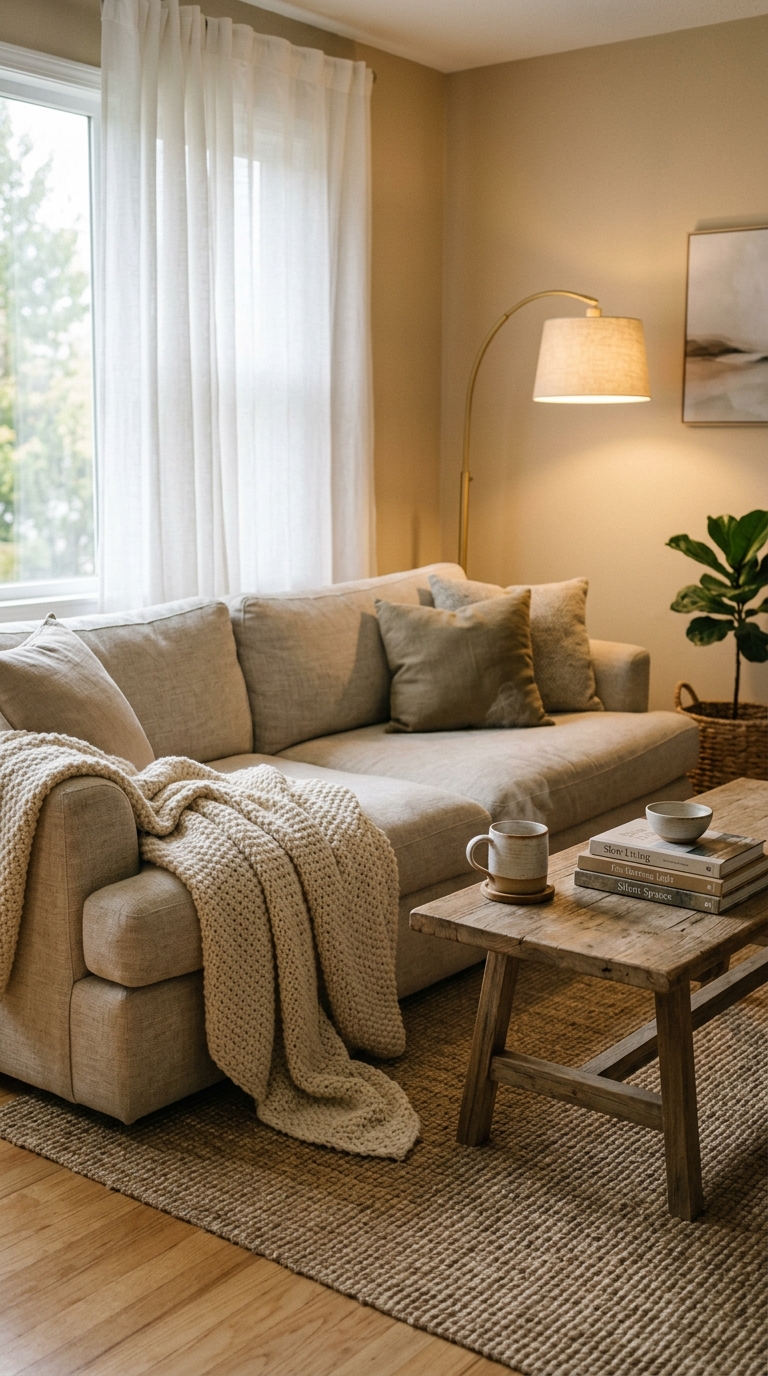
That’s what a linen-layered living room does to you — it wraps the whole space in this quiet, unhurried warmth that nothing else quite replicates.
The walls are a shade somewhere between warm white and pale sand, the kind of color that shifts beautifully depending on whether the afternoon sun is hitting it directly or the evening lamp is glowing low.
Every surface feels intentional but never stiff, layered but never cluttered, and the room breathes in a way that makes you want to stay in it for hours without looking at your phone once.
The secret to getting this look right is understanding that linen works because of its texture, not just its color.
When you’re shopping for your sofa, look for a fabric that has a very slight weave variation — that subtle inconsistency in the threads is what gives linen its soul.
Layer your seating with at least two throw pillow weights — something structured in a natural canvas and something softer in a washed linen blend — so the sofa looks genuinely lived in rather than staged.
Your curtains should be hung high, as close to the ceiling as possible, in the most lightweight sheer linen you can find, because the way natural light passes through that fabric in the morning is honestly one of the most beautiful things a living room can offer you.
The Warm Greige Foundation
Greige — that gorgeous middle ground between gray and beige — is genuinely one of the most flattering colors you can put on a living room wall, and once you live with it, you will never go back to a flat cool gray again.
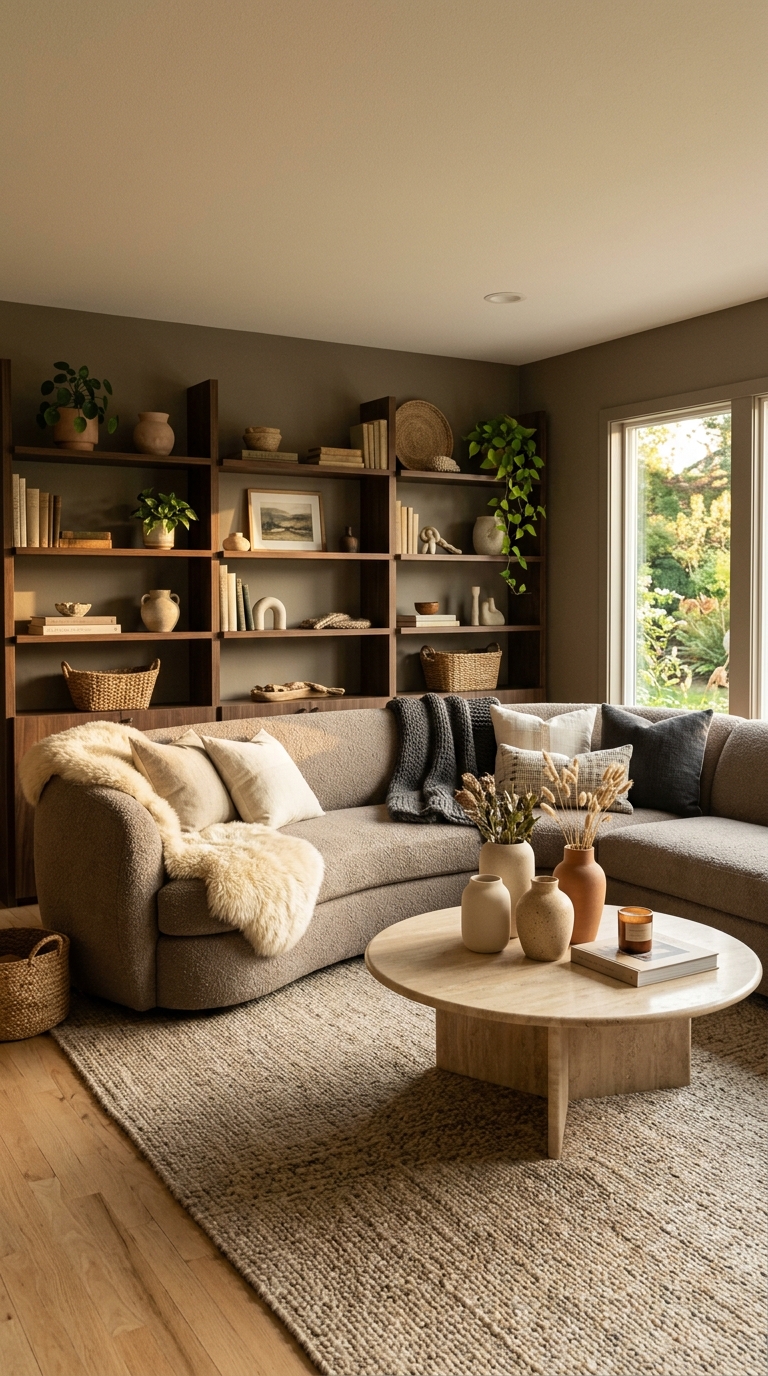
There’s a depth to a well-chosen greige that changes character throughout the day — it reads almost taupe in bright morning light, shifts into something richer and moodier as the afternoon fades, and then glows warmly under lamp light in the evening like the walls themselves are lit from within.
A curved sectional in a boucle or bouclé-adjacent fabric anchors this palette beautifully because the texture catches light in a way that prevents the room from ever looking flat or one-dimensional.
When you add a round travertine or stone coffee table into that mix, the natural veining in the stone brings in just enough visual movement to keep the eye interested without introducing any real color.
Choosing the right greige for your specific room requires testing at least three shades on your actual wall before committing, because the natural light in your space will completely transform how each one reads.
Look for warm undertones — lean toward something with a yellow or red base rather than a blue or purple one, because cool-based greiges can shift muddy and flat in low-light rooms.
Layer your soft furnishings in tones that sit just above and just below your wall color — think warm cream, soft camel, deep taupe — so the whole room wraps around you like a cohesive cocoon.
Add matte black or dark walnut accents in small doses — a picture frame, a lamp base, a shelf bracket — because those deeper tones give the room an anchor point that keeps everything from floating away into softness.
The Textured White Canvas
A white living room done wrong feels like an empty waiting room — cold, blank, and impossible to relax in.
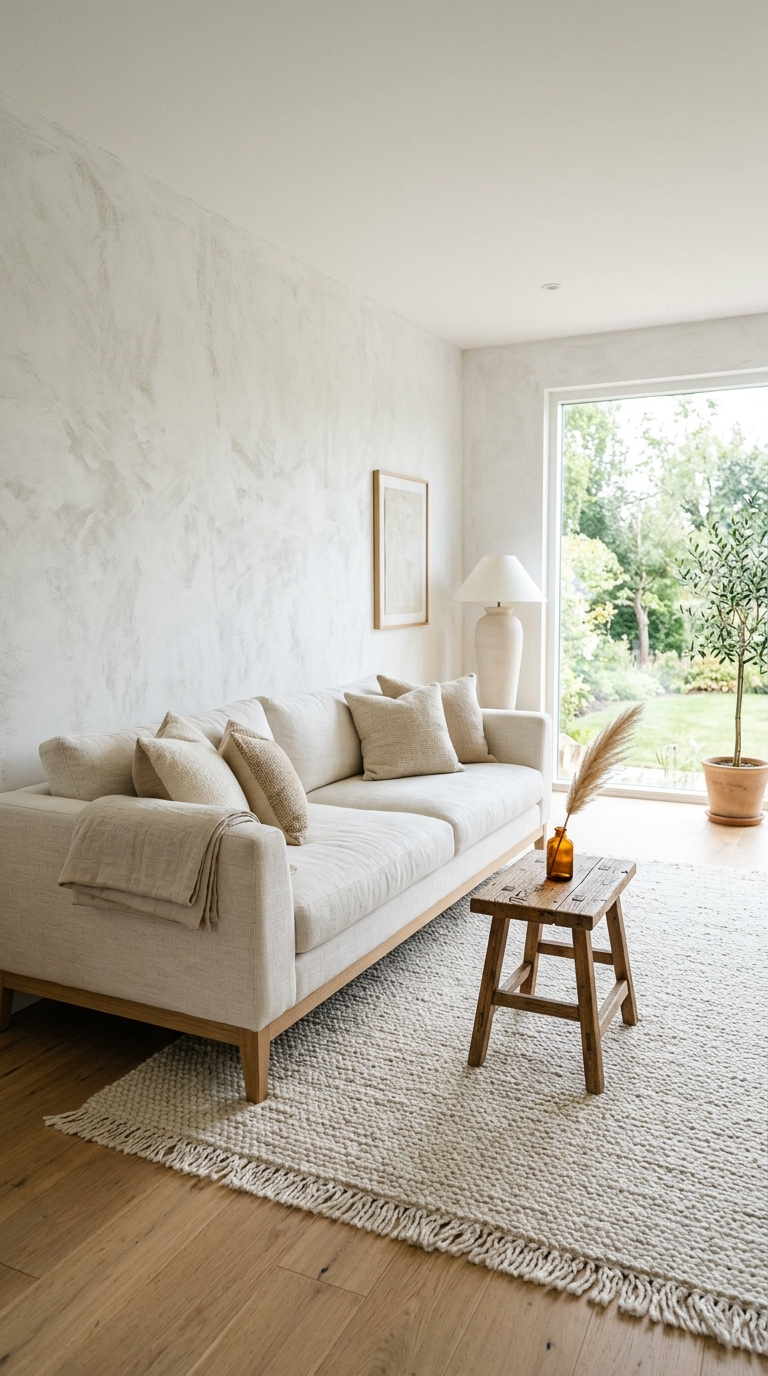
But a white living room done right, with real attention paid to texture and material variation, feels like the most peaceful, expansive, and genuinely beautiful space you have ever sat in.
The walls are not a flat builder’s white — they’re limewashed or Venetian plastered or painted with a matte finish that has just enough depth to show variation when light moves across them, and that variation is what gives the room its soul.
The sofa is off-white rather than bright white, because that single degree of warmth makes the whole room feel approachable instead of clinical, and it photographs beautifully in every season.
The most important element in a textured white living room is the rug, because without it the whole composition reads too cold and disconnected from the floor.
Choose a handwoven wool or a jute-blend rug in a tone that is slightly warmer than your walls — ivory, natural, or undyed wool — and make sure it is large enough that all your seating sits on it comfortably, because an undersized rug is one of the most common mistakes that breaks the whole visual.
Build your material story around contrast in texture rather than contrast in color — think:
- Smooth plaster walls against a nubby woven throw
- A glass vase beside a rough clay bowl
- Polished stone next to unfinished raw wood
- Tight-woven fabric cushions beside looser, more open-weave ones
Every material you add should feel different to the touch from the one beside it, because that tactile variety is what makes a white room feel incredibly rich rather than deliberately spare.
The Warm Wood and Cream Pairing
Wood and cream together create a warmth that goes well beyond aesthetic — it actually changes how you feel in the space, in the best possible way.
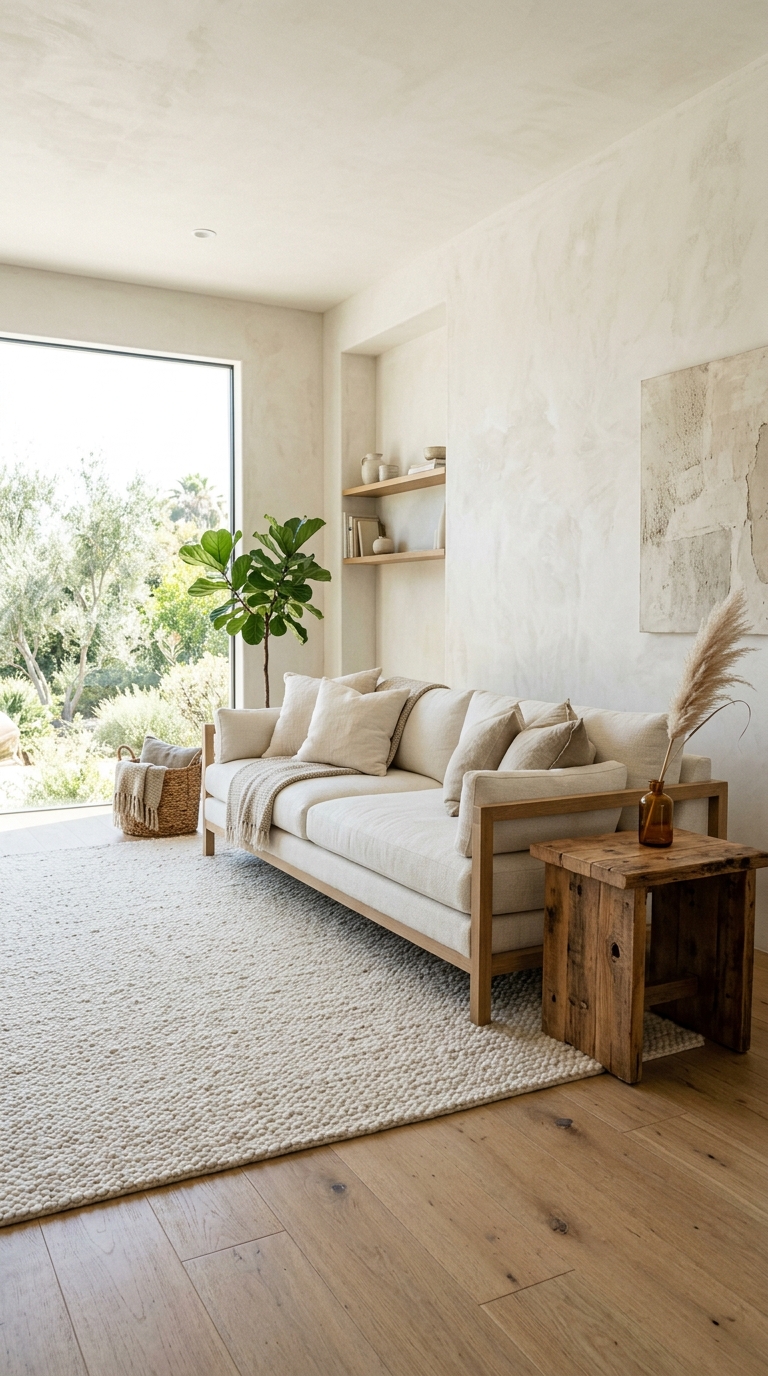
There is something deeply grounding about the combination of natural wood grain and a soft creamy palette — it connects the room to the natural world without you having to add a single plant, and it wraps you in a sense of quiet comfort the moment you walk through the door.
The floor is where this pairing really sings, especially if you have natural wood or can introduce it through a large wooden bench, media console, or even a beautiful coffee table with real grain and knot character.
Cream on the walls, cream on the sofa, and then that warm honey-toned wood woven through every level of the room creates a visual harmony that is incredibly easy to live with and never tires you out the way a high-contrast room eventually can.
Getting the wood tones right is genuinely the make-or-break factor in this pairing, because not all wood plays well with cream.
Lean toward lighter, warmer woods — white oak, ash, light walnut, pine with a natural finish — and avoid anything with a cool gray or greenish undertone, because those shades will fight with your cream rather than complement it.
Keep your wood pieces at different heights throughout the room so the eye travels naturally — a low coffee table, a medium-height console, and a taller shelving piece create a rhythm that feels considered and genuinely design-forward.
Let the grain and the natural imperfections of the wood show — don’t fill knots, don’t over-sand, and don’t lacquer to a high shine, because the raw honesty of the material is exactly what makes this pairing feel warm and real rather than showroom-perfect.
The Stone and Sand Living Room
Sand and stone tones in a living room create a palette so naturally grounding that the space almost seems to breathe on its own — slow, steady, and completely at ease.
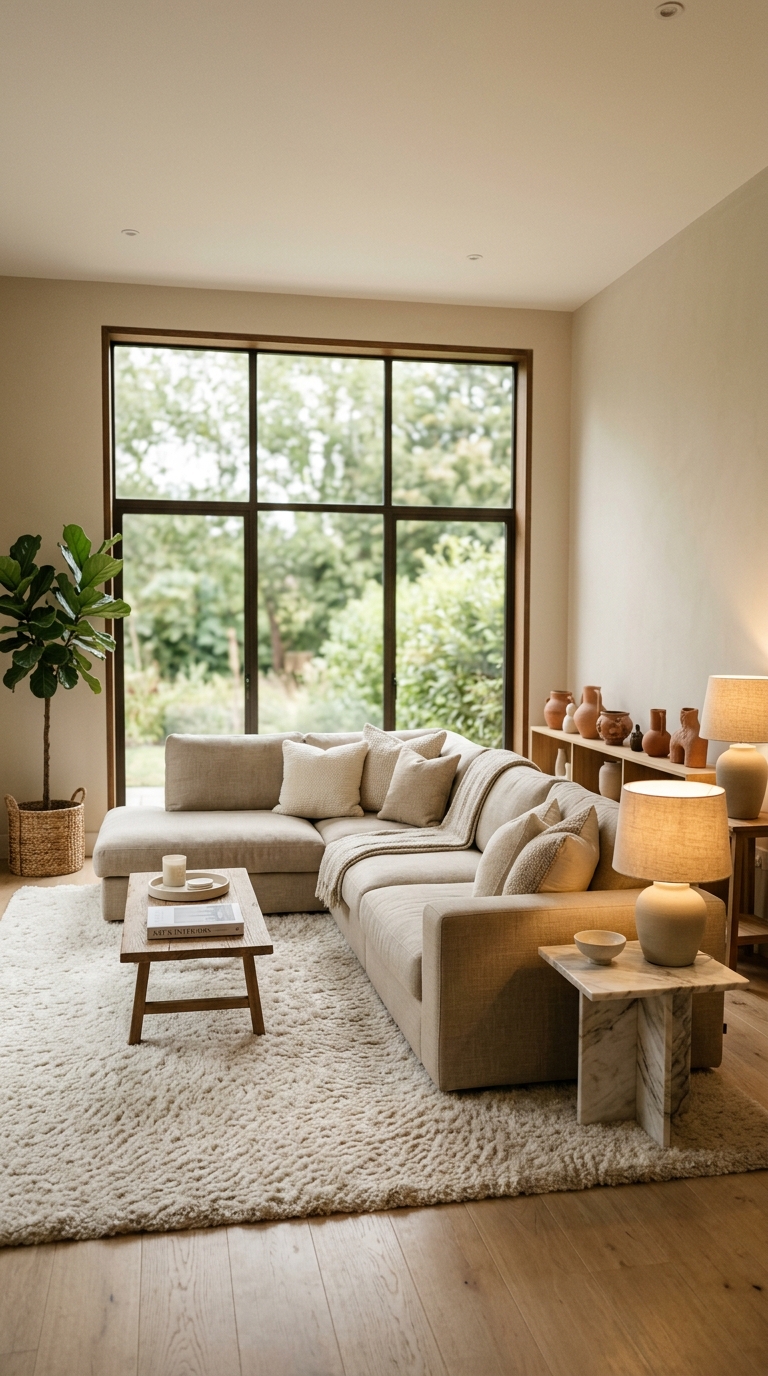
These are the colors of the earth itself — the pale limestone cliffs, the warm desert floor, the smooth river-washed pebbles — and when you bring them inside, your nervous system responds to that familiarity in the most calming, restorative way.
A modular sofa in a sandy linen or cotton blend anchors the room without dominating it, and because sand is so inherently neutral, you can pivot your accent pieces with the seasons without ever needing to change a major piece of furniture.
Add marble or real stone wherever you can afford to — a side table, a small tray, a set of coasters — because the veining in natural stone is one of the most beautiful organic patterns that exists, and it introduces visual complexity without adding a single drop of color.
The terracotta accent is your secret weapon in a stone and sand living room, because it brings in the warmth of the earth palette without pushing the room into any recognizable color story.
One or two terracotta ceramic pieces — a tall vase, a small bowl, a planter — will make the whole room feel intentional and curated without looking like you tried too hard.
Keep your textiles in the lightest, most natural versions of your palette — undyed linen, raw cotton, unbleached canvas — so the room maintains that genuine, organic quality that makes the stone-and-sand palette feel so incredibly authentic.
Step back periodically as you style and squint at the room — if everything reads as one seamless tonal flow from floor to ceiling, you are doing it exactly right.
The Moody Neutral with Dark Accents
Not every neutral living room needs to be light and airy — sometimes the most beautiful neutral spaces are the ones that lean into depth, shadow, and a rich, cocooning darkness that wraps you up like a favorite sweater on a winter evening.
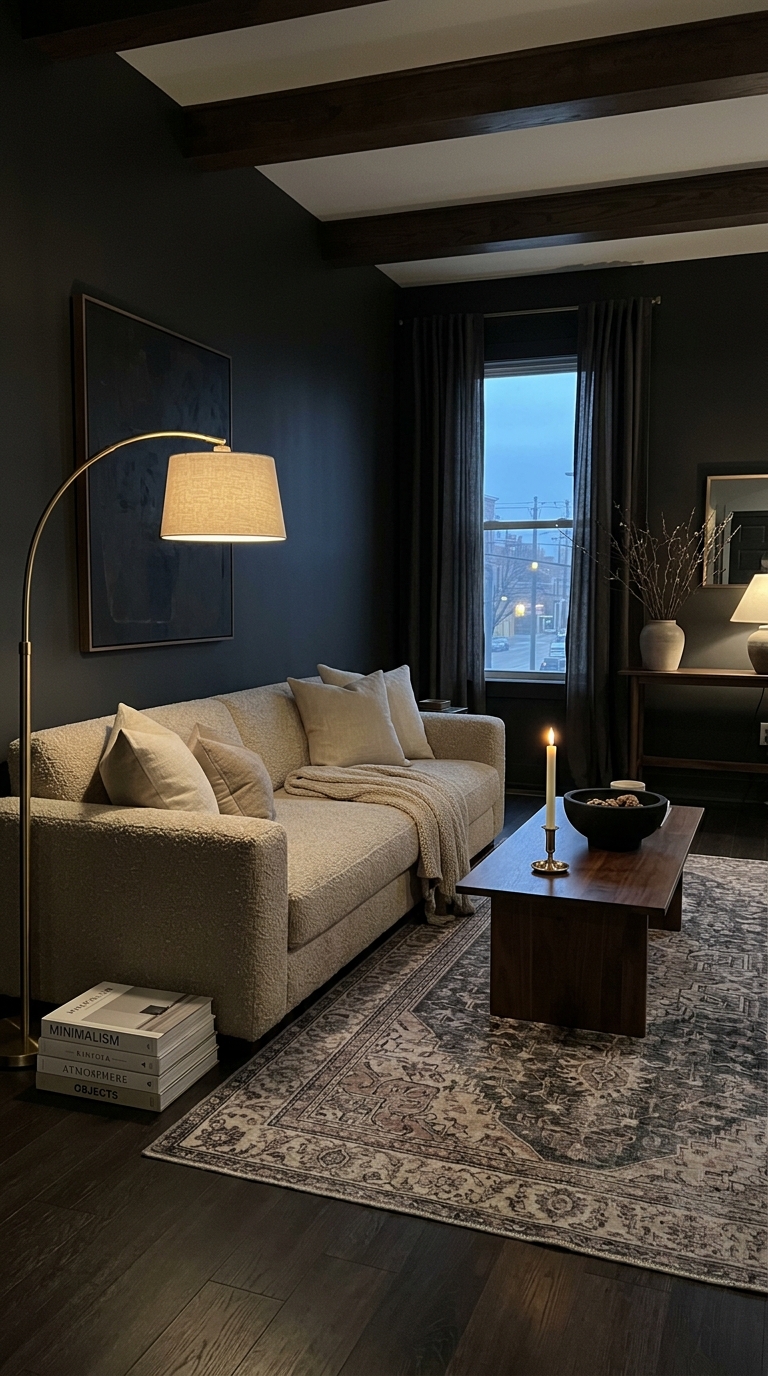
A charcoal or deep warm gray wall might sound like a departure from the neutral palette, but the truth is that dark neutrals are just as much a part of the family as pale cream and warm white — they just tell a different, more dramatic, deeply intimate story.
The key to making a dark neutral room feel warm rather than oppressive is pairing those walls with textiles that have genuine light-catching texture — a boucle sofa, a wool rug, a linen throw all catch ambient light in different ways, and that interplay between the dark walls and the textured softness of the furnishings is genuinely breathtaking.
Brass and warm bronze accents belong here — a lamp, a picture frame, a side table leg — because those warm metallics glow against a dark wall in the evening lamplight in a way that feels deeply luxurious and completely effortless.
One candle on the coffee table does more for the atmosphere of a dark neutral living room than any overhead lighting fixture ever could, so invest in a beautiful pillar candle or a cluster of varying heights on a stone tray and light them every single evening.
Make sure your dark neutral room has at least one source of natural light — a large window, a glass door, a skylight — because the contrast between that natural brightness and the deep wall color is the visual tension that keeps the room from feeling like a cave.
Layer rugs if you have wood floors — a large, muted-toned vintage or Persian-inspired rug grounds the entire furniture arrangement and introduces just enough pattern to give the eye a place to rest without disrupting the moody, enveloping atmosphere you have worked so hard to create.
The Japandi-Inspired Neutral Space
Japandi — that beautiful design philosophy born from the meeting of Japanese wabi-sabi and Scandinavian hygge — produces living rooms that feel like a visual exhale, and once you have experienced that kind of intentional simplicity, ordinary spaces start to feel cluttered and loud in comparison.
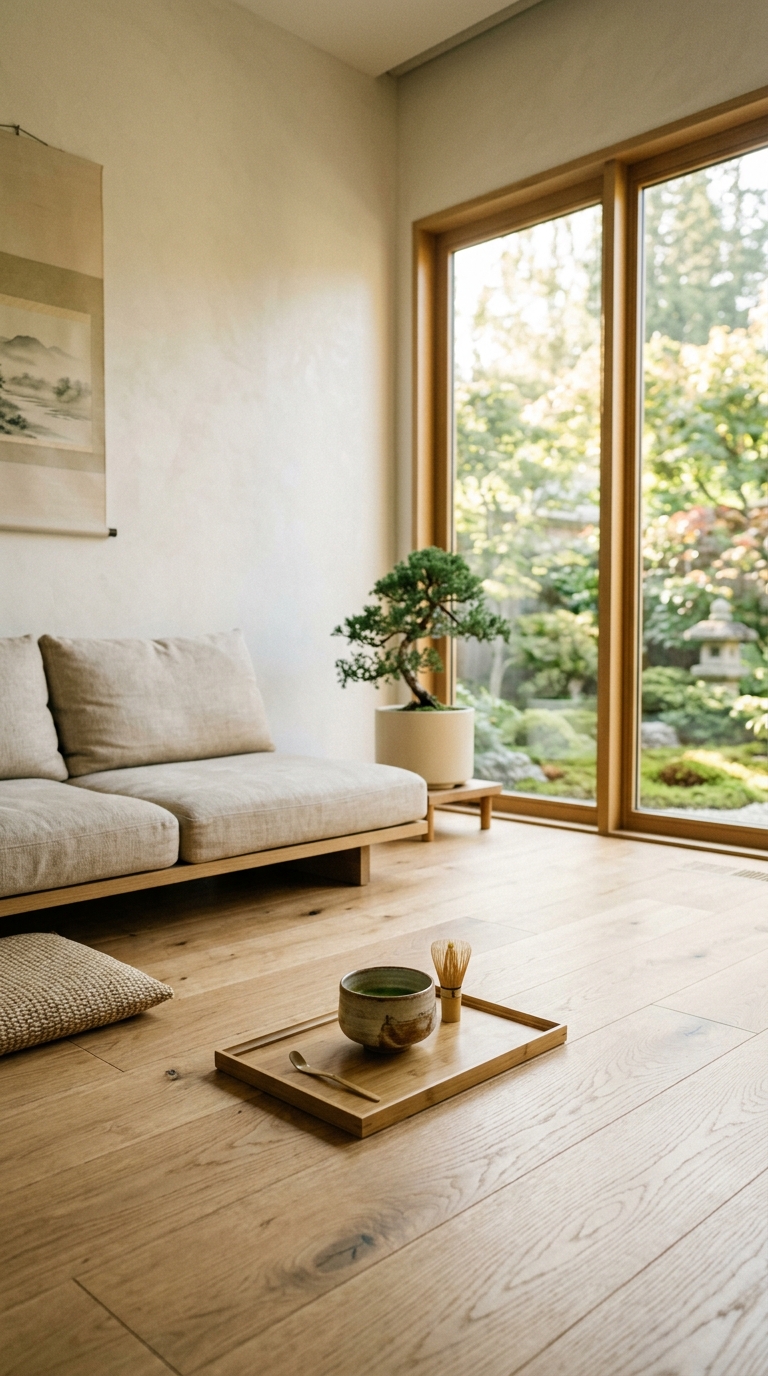
The palette is always neutral, always warm, always grounded in natural materials, and the entire philosophy rests on the idea that every single object in the room should earn its place — not because it fills a gap, but because it genuinely adds something beautiful or purposeful to the whole.
A low-profile sofa, a floor-level tray acting as a coffee table, a single plant chosen for the beauty of its form rather than its lushness — this is a room that understands restraint not as deprivation but as the highest form of curation.
The walls are often left almost entirely bare, because in a Japandi room the texture and warmth of the materials themselves become the art — the grain of the wood, the irregularity of a handmade ceramic, the gentle undulation of a linen weave.
Choosing fewer, better things is the single most important shift you can make if you want to move your living room toward a Japandi aesthetic, and it is genuinely harder than buying more — it requires you to look honestly at every piece you own and ask whether it is truly beautiful or truly useful.
Start by removing anything from your living room that you would not specifically choose to add if you were starting fresh today, and then sit with the emptiness for a few days before you add anything back, because you will discover that most rooms need far less than we think they do.
Natural light is your most important design element in a Japandi space — treat your windows as features, keep them as clear and unobstructed as possible, and use the shadows that move across your walls throughout the day as the most beautiful free artwork you will ever own.
The Cozy Cottage Neutral
A cottage-style neutral living room feels like the warmest hug a room can give you — everything is soft, slightly imperfect, deeply comfortable, and layered with the kind of gentle charm that makes you want to curl up with a good book and absolutely nothing else on your agenda.
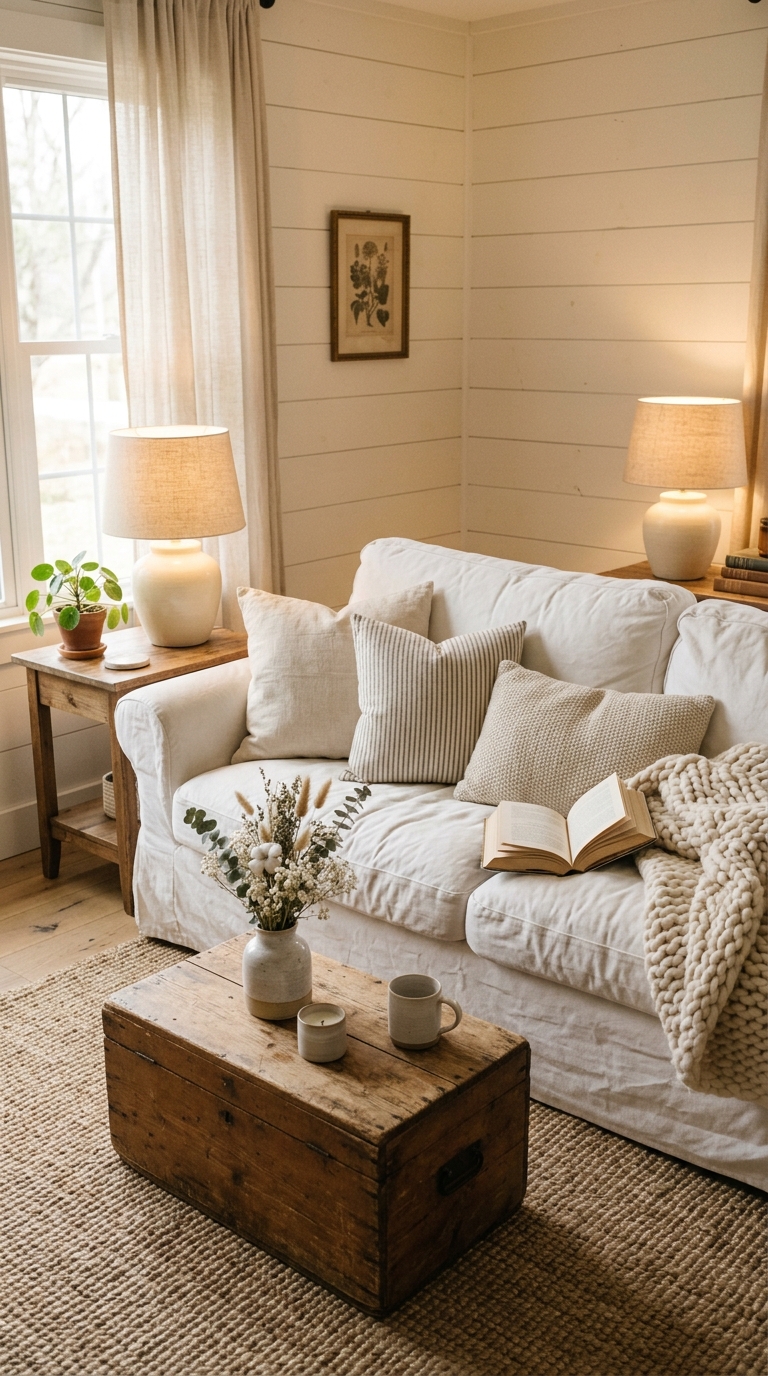
The beauty of this style is in its deliberate embrace of imperfection — the slightly wrinkled slipcover, the worn edge of a wooden trunk, the dried flowers that have faded slightly from cream to the most beautiful pale wheat — all of these “imperfections” are actually what make the room feel so genuinely lived in and loved.
Shiplap or beadboard walls in a warm matte white are such a perfect backdrop for this aesthetic because they add architectural interest and texture without drawing the eye away from the softness of the furnishings, and they reference a slower, more handmade approach to building that feels deeply aligned with the cottage spirit.
Layer every surface gently — the sofa gets extra cushions and a throw, the coffee table gets a simple arrangement of flowers and a candle, the windowsill gets a small stack of books — because this is a room that celebrates accumulation of the quiet, meaningful kind.
The slipcover sofa is genuinely one of the best investments you can make for a cottage neutral living room because it gives you the softly rumpled, lived-in quality that looks effortlessly beautiful while also being completely washable, which is a practical gift you will thank yourself for every single time someone spills something.
Look for loose-fit slipcovers in washed cotton, stone-washed linen, or canvas, because the slight fading and softening that happens with repeated washing only makes them more beautiful over time, not less.
Bring in natural dried botanicals wherever they feel right — pampas stems, cotton branches, dried lavender tied in loose bunches — because they add organic form and movement without the upkeep of living plants, and in a neutral palette they read as incredibly sculptural and intentional.
The Open Plan Neutral That Actually Works
Open plan living sounds like a dream — and it absolutely can be — but the single most common reason neutral open plan spaces fall flat is that people treat the whole floor plate as one undifferentiated zone instead of a series of connected but distinct moments that each have their own identity.
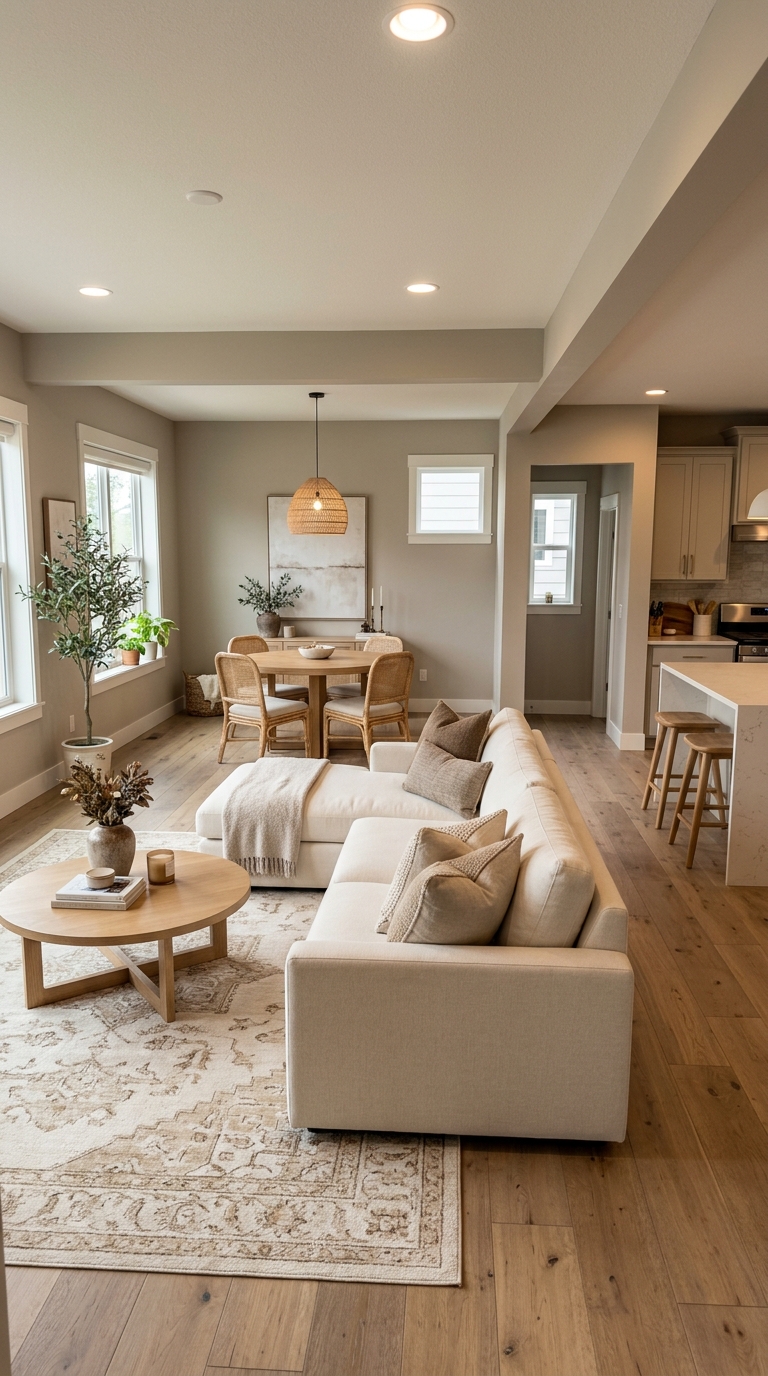
The living area, the dining area, and the kitchen all need to feel like they belong to the same family — same palette, same material story, same light quality — while each one still reads as a separate, purposeful space with its own center of gravity.
A large area rug is the single most powerful tool you have for defining your living zone within an open plan, and it needs to be big — genuinely large, bigger than your instinct tells you — because the rug is what draws the boundary between the seating area and everything around it.
When your palette is neutral throughout, the definition between zones comes entirely from furniture scale, rug placement, and lighting — so think carefully about where your pendants hang, where your floor lamps stand, and how the furniture arrangement creates its own natural conversation around a central anchor point.
Consistent flooring throughout is the greatest gift you can give an open plan neutral space because it allows the eye to travel freely and makes the whole area read as larger and more intentional than rooms that switch materials from zone to zone.
If you already have consistent flooring and want to warm the space further, focus on varying your ceiling light fixtures between zones — a sculptural pendant over the dining table, recessed warmth over the living area, and under-cabinet lighting in the kitchen creates three distinct pools of warmth that define each zone beautifully without a single wall to help you.
Keep your accessories grouped rather than scattered throughout the open plan — one well-styled coffee table, one beautiful dining table centerpiece, one meaningful shelf arrangement — because concentrated moments of beauty read so much more powerfully in a large open space than objects spread thinly across every surface.
The Gallery-Worthy Neutral Living Room
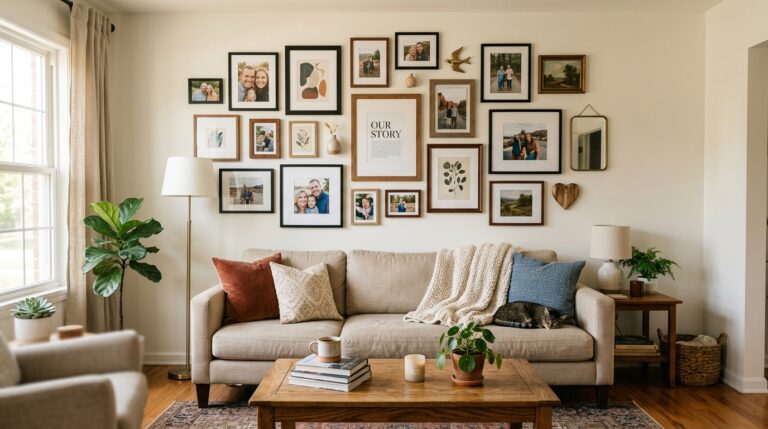
Art transforms a neutral living room from a beautifully decorated space into something that actually moves you — and the most exciting thing about a neutral palette is that it gives artwork the cleanest, most powerful stage it will ever get, because nothing in the room competes with it.
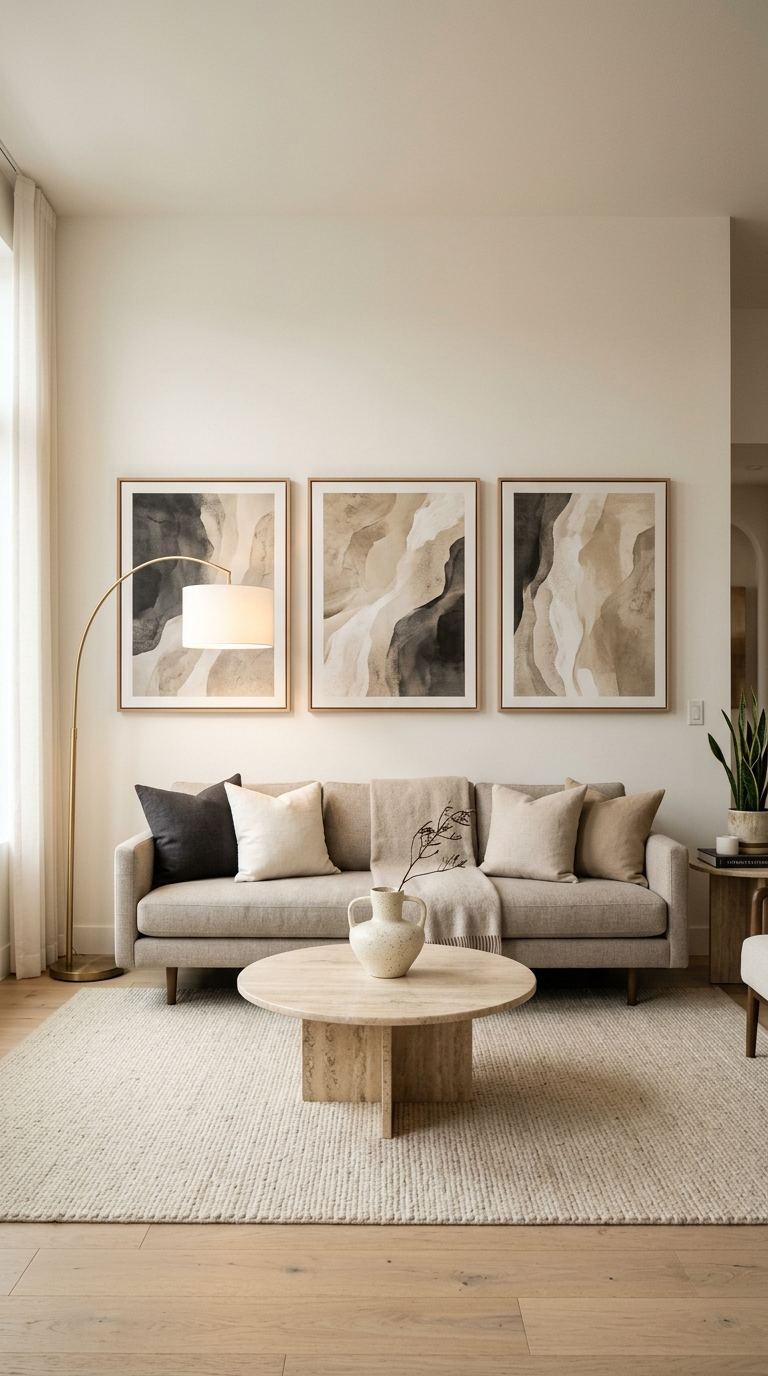
A gallery-worthy living room does not require expensive original art — it requires thoughtful curation, correct scale, and the confidence to hang things where they will actually make an impact rather than where conventional wisdom says they should go.
One enormous piece hung slightly lower than you think you should will stop you in your tracks every time you walk into the room, and that moment of genuine surprise and pleasure is worth more than a hundred perfectly arranged decorative objects on a shelf.
The neutrality of the palette means that the art can go in any direction — abstract expressionism, botanical illustration, architectural photography, sculptural ceramics mounted on a wall — and it will always look intentional because the room gives it room to breathe and be seen properly.
Choosing art in tones that echo your room’s palette rather than contrast sharply with it keeps the gallery feel cohesive and calm rather than visually jarring — look for pieces where the dominant tones sit within your neutral color family even if the art itself is dynamic and expressive.
Frame your artwork consistently — all natural wood, all thin black metal, all raw gallery-wrap canvas — because mixed frames across a wall create visual competition that distracts from the art itself and makes the whole arrangement read as accidental rather than intentional.
Lean large canvases against the wall rather than hanging them if you want a more relaxed, contemporary gallery feel — one oversized canvas propped against the wall beside the sofa creates an incredibly effortless moment that looks both casual and genuinely sophisticated at the same time.
The Hygge Neutral Cocoon
Hygge — the Danish concept of coziness, togetherness, and the particular pleasure of ordinary comfort — finds its purest expression in a living room that is built entirely around the act of making you feel safe, warm, and genuinely at peace with nowhere else to be.
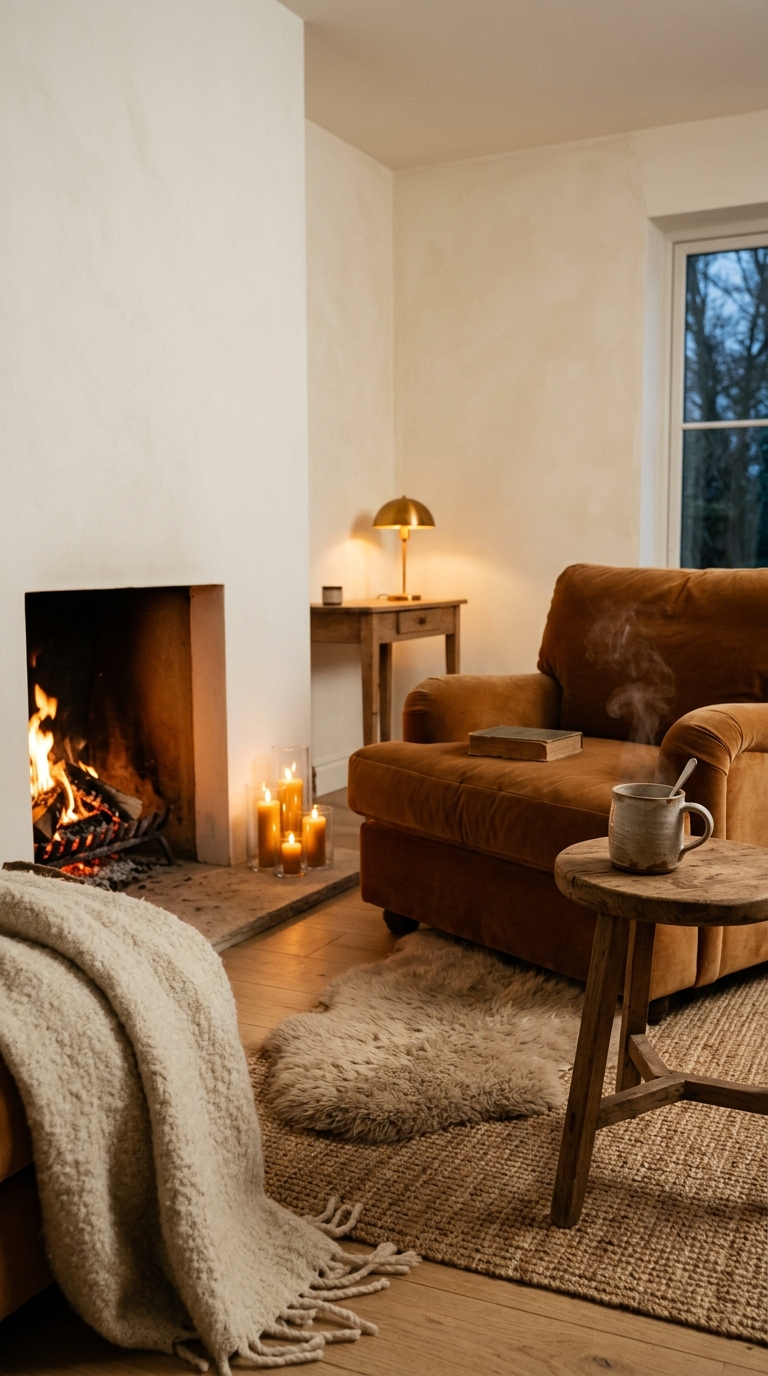
A hygge neutral living room is not about perfection — it is about softness, warmth, genuine comfort, and the feeling that whoever walks into the room is immediately welcome to stay as long as they like, without any pressure to be impressive or tidy or on.
The armchair beside a fireplace — or a beautifully styled fireplace mantle even without a flame — is the heart of a hygge living room, and everything else in the space radiates outward from that central gesture of warmth and invitation.
Candles are non-negotiable — not as decoration but as genuine atmosphere builders — and in a hygge neutral room they work better in clusters than as individual pieces, because the collective warmth of multiple small flames creates the kind of golden, flickering light that makes any space feel like the exact right place to spend an evening.
The layered rug technique — a natural jute or sisal base rug with a softer, plushier rug layered on top — is one of the best hygge investments you can make, because underfoot softness is something your body registers even before your eyes do, and walking barefoot onto a soft layered rug the moment you come home is one of the small daily pleasures that accumulates into real happiness over time.
Dedicate a basket or a beautiful wooden crate near your seating to holding extra blankets and throws — not because it looks good in photographs (though it does) but because having that warmth immediately accessible without having to go looking for it is genuinely what hygge is all about.
Keep your lighting exclusively warm-toned throughout a hygge living room — no cool white bulbs, no harsh overhead lighting — and layer your light sources between floor lamps, table lamps, and candles so you can always create the exact warmth level the moment calls for.
The Effortless Neutral Living Room for Real Life
Every gorgeous neutral living room you have ever admired in a magazine is beautiful — but the truest test of any living room design is how it holds up on an ordinary Tuesday when the kids have been home all afternoon, someone left a coffee ring on the table, and the throw has been used as a fort and not yet re-folded.
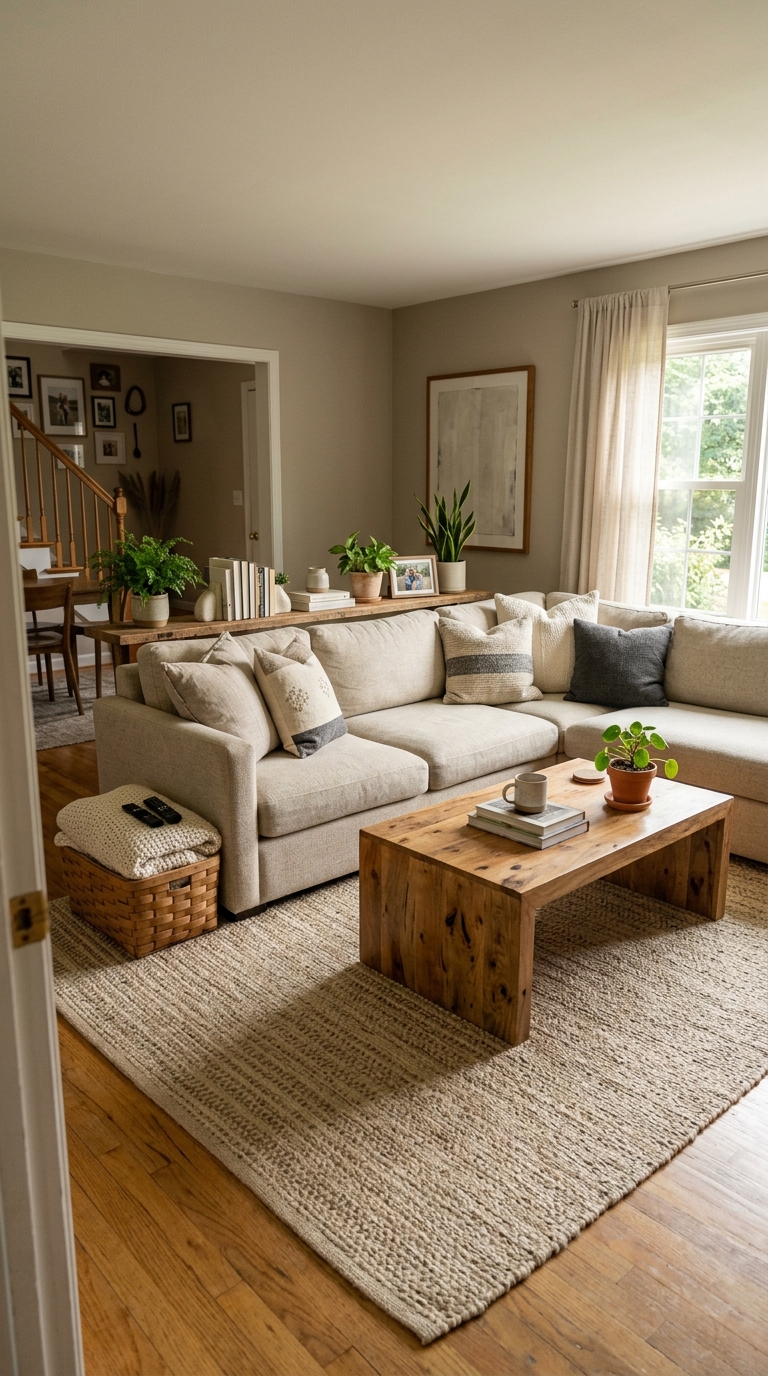
The best neutral living rooms are not the ones that look perfect in photographs — they are the ones that look beautiful and feel genuinely welcoming in real, everyday life, with real people, real mess, and all the beautiful unpredictability that comes with actually living in a home rather than curating it.
Performance fabrics have come so far in the last several years that you can now get sofas in exactly the warm, soft, neutral tones that look like designer pieces — and they clean up with water, resist staining, and hold their shape across years of actual use, which means you never have to choose between beauty and practicality.
Natural wood with character — knots, grain variation, small surface marks — is always more interesting than perfect wood, and it shows the daily signs of use with a patina rather than damage, which is the most stress-free surface a living room coffee table can have.
Building your living room around durability first and aesthetics second does not mean sacrificing beauty — it means that the beauty you create will actually last and keep giving you joy years from now instead of looking tired and worn within eighteen months of constant real life.
Choose your rug in a pattern — even a very subtle natural flatweave or a tone-on-tone texture — rather than a solid color if you have a high-traffic household, because patterned rugs hide everyday dirt and wear in a way that solid rugs simply cannot, and you deserve a living room that looks beautiful without requiring constant vigilance.
Style your shelves and surfaces with objects that you genuinely love rather than things you feel you should love, because you interact with your living room every single day, and the joy of being surrounded by things that are personally meaningful to you is the quiet, sustaining kind of happiness that no amount of trend-following can ever manufacture.
Your home is supposed to feel like the best version of you — not a showroom, not a Pinterest board, but a real, breathing, living space that holds you gently at the end of every single day.
Pick just one of these twelve ideas that spoke to you most strongly, and take one small step toward it this week — maybe it’s ordering a linen throw in a new texture, or swapping out a harsh overhead bulb for something warmer, or finally committing to that greige paint color you have been saving for months.
Neutral living rooms are not about doing less — they are about doing the right things with real intention, and the payoff is a space that genuinely restores you every time you come home to it.
You deserve that kind of home, and honestly, you are so much closer to it than you think.